

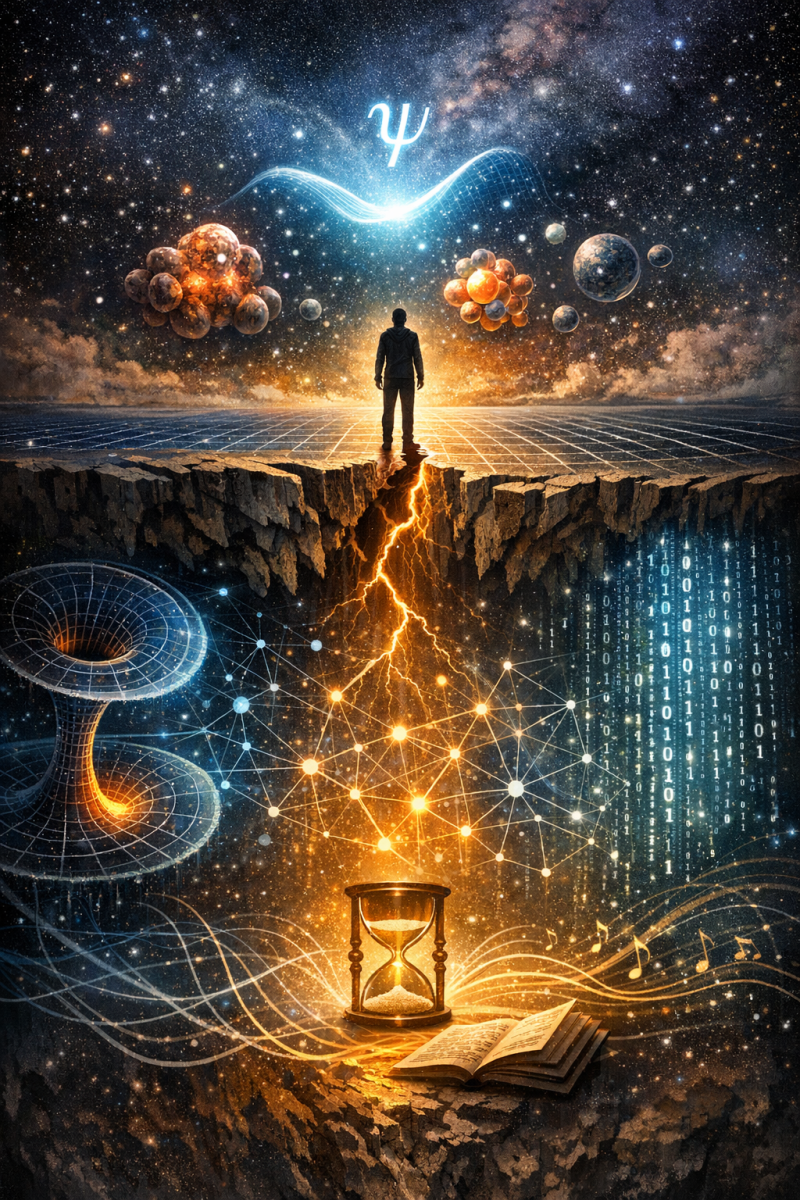
Every now and then, when I stare too long into fundamental physics, a question resurfaces:
Is quantum mechanics the ultimate level of reality, or is it just a surface?
We are used to thinking of science as a progressive descent: molecules, atoms, nuclei, quarks. Each time we dig we find something more elementary. It's natural to wonder: beneath quantum mechanics, is there a further layer? Or have we reached the bottom?
Yet.
There are conceptual cracks we cannot ignore:
- The measurement problem: what is collapse really?
- Entanglement: why is nature intrinsically non-local?
- The incompatibility with general relativity.
- The fact that the wave function lives in a mathematical space of very high dimensionality, not in the three-dimensional space we inhabit.
This is where the ontological doubt arises. This is where the ground begins to tremble beneath our feet.
In this view:
- Particles are excitations of fields.
- Fields are mathematical structures.
- Mathematical structures describe correlations.
- Correlations are information.
At that point the question becomes almost philosophical:
information with respect to what?
Is a physical substrate needed? Or is information ontologically primary?
We think in terms of cause and effect because we live in a well-defined macroscopic spacetime. But at a deeper level there might only exist a global structure of correlations, without a privileged temporal direction.
Time itself might be emergent.
And this completely changes our intuition about what "reality" means. It also changes the way we experience the present: perhaps the moment we are living through is not a point on a line, but a node in a network.
When we listen to it, we perceive melody, harmony, rhythm. But if we analyze it note by note we lose the global structure. Perhaps we are doing the same with physics: we look for fundamental building blocks, but reality might be more like a global relational structure than a collection of pieces.
Not "things" that interact, but a single structure that manifests as things.
And perhaps this is exactly what happens when we stop analyzing and begin to go through: we perceive the music, not the notes.
But it is also possible that we are asking the wrong question.
Perhaps there is no "beneath". Perhaps there is a level where the distinction between object, space, time and information loses meaning.
Perhaps the bottom is not a place, but a way of looking.
We have two extraordinarily accurate theories:
- quantum mechanics
- general relativity
They work perfectly in their respective domains. But they do not speak the same language.
This fracture suggests that something is missing. And when in the history of physics a deep conceptual fracture has appeared, a revolution has always come.
Perhaps we are right on the edge of one.
- Spacetime is not fundamental.
- Particles are not primary entities.
- Reality is structurally relational.
Not a collection of objects, but a network of quantum correlations.
Matter would then be a stable manifestation of a deeper informational dynamic. A bit like vortices in a fluid: they seem like objects, but they are patterns.
If space emerges, if time emerges, if causality emerges, then even our conscious experience is a phenomenon internal to a much deeper structure.
We are temporary nodes in a cosmic network of correlations.
And perhaps the "ontological level" is not something hidden beneath visible reality, but is reality itself seen from a broader perspective. A perspective that the body, in its traversing, perhaps glimpses.
Perhaps the right question is not:
"What is beneath quantum mechanics?"
But:
"What do we really mean when we say that something is real?"
And here the small cosmic diary transforms into a great open question.
Which is perhaps exactly the best place to be, in this historical moment: with a question too large to contain, yet too necessary to avoid.
``` The (almost embarrassing) solidity of quantum mechanics
Quantum mechanics works impressively. Its predictions are confirmed with precision that borders on the incredible. The standard model describes ordinary matter with an accuracy that no previous theory had ever achieved.Yet.
There are conceptual cracks we cannot ignore:
- The measurement problem: what is collapse really?
- Entanglement: why is nature intrinsically non-local?
- The incompatibility with general relativity.
- The fact that the wave function lives in a mathematical space of very high dimensionality, not in the three-dimensional space we inhabit.
This is where the ontological doubt arises. This is where the ground begins to tremble beneath our feet.
Epistemology or ontology?
The central question is this: does the wave function describe reality or only our information about it? If it is only information, then beneath quantum mechanics there might exist a deeper level, perhaps deterministic, that we only see probabilistically. If instead the wave function is real, then fundamental reality is not made of localized particles in space, but of something much more abstract. And here the ground no longer trembles: it splits.What if space is not fundamental?
In recent decades a radical idea has been emerging: space might not be a primary ingredient of reality. Some theoretical results suggest that the geometry of spacetime could be reconstructed from the entanglement structure between quantum states. In other words: the distance between two points might be a measure of how quantumly correlated they are. If this were true, three-dimensional space would not be the "container" of things, but an emergent phenomenon from deeper relations. Not objects in space, but relations that generate space.Reality as a network of correlations
Perhaps the ontological level is not made of "things", but of correlations. Classical physics was a physics of objects: particles with defined position and velocity. Quantum mechanics tells us something different: what is fundamental is not the value of a property, but the relationship between systems. Entanglement is not a secondary effect: it is structural. It is as if nature were a network in which the nodes have no identity independent of the connections. This is a huge paradigm shift. And perhaps it is also something that the body, in its own way, already knows: that we are relation before being individuals.The informational hypothesis
Another line of thought suggests that information is the deepest level. Not matter, not energy, but quantum information.In this view:
- Particles are excitations of fields.
- Fields are mathematical structures.
- Mathematical structures describe correlations.
- Correlations are information.
At that point the question becomes almost philosophical:
information with respect to what?
Is a physical substrate needed? Or is information ontologically primary?
And causality?
If space can emerge from entanglement, causality might also not be fundamental.We think in terms of cause and effect because we live in a well-defined macroscopic spacetime. But at a deeper level there might only exist a global structure of correlations, without a privileged temporal direction.
Time itself might be emergent.
And this completely changes our intuition about what "reality" means. It also changes the way we experience the present: perhaps the moment we are living through is not a point on a line, but a node in a network.
A useful analogy
Let's imagine a symphony.When we listen to it, we perceive melody, harmony, rhythm. But if we analyze it note by note we lose the global structure. Perhaps we are doing the same with physics: we look for fundamental building blocks, but reality might be more like a global relational structure than a collection of pieces.
Not "things" that interact, but a single structure that manifests as things.
And perhaps this is exactly what happens when we stop analyzing and begin to go through: we perceive the music, not the notes.
Have we reached the bottom?
It is possible that quantum mechanics is not the ultimate level. It could be the emergent limit of an even deeper theory, just as classical mechanics is the limit of quantum mechanics when ℏ tends to zero.But it is also possible that we are asking the wrong question.
Perhaps there is no "beneath". Perhaps there is a level where the distinction between object, space, time and information loses meaning.
Perhaps the bottom is not a place, but a way of looking.
The historical phase we are in
There is something fascinating about the current historical moment.We have two extraordinarily accurate theories:
- quantum mechanics
- general relativity
They work perfectly in their respective domains. But they do not speak the same language.
This fracture suggests that something is missing. And when in the history of physics a deep conceptual fracture has appeared, a revolution has always come.
Perhaps we are right on the edge of one.
A personal reflection
If I had to bet, I would say that:- Spacetime is not fundamental.
- Particles are not primary entities.
- Reality is structurally relational.
Not a collection of objects, but a network of quantum correlations.
Matter would then be a stable manifestation of a deeper informational dynamic. A bit like vortices in a fluid: they seem like objects, but they are patterns.
And us, inside all this?
The most dizzying thing is that we too are part of that network.If space emerges, if time emerges, if causality emerges, then even our conscious experience is a phenomenon internal to a much deeper structure.
We are temporary nodes in a cosmic network of correlations.
And perhaps the "ontological level" is not something hidden beneath visible reality, but is reality itself seen from a broader perspective. A perspective that the body, in its traversing, perhaps glimpses.
Perhaps the right question is not:
"What is beneath quantum mechanics?"
But:
"What do we really mean when we say that something is real?"
And here the small cosmic diary transforms into a great open question.
Which is perhaps exactly the best place to be, in this historical moment: with a question too large to contain, yet too necessary to avoid.