

INIZIO
-dense at the center
-increasingly diffuse toward the বাইরে
The key question is: how quickly does this density change?
This is not a minor detail. Inside that answer lies the entire history of the halo:
-how it formed
-how many mergers it experienced
-how dynamically “relaxed” it is
👉 the slope of the profile changes in a “preset” way
In other words, it imposes a universal structure.
This works surprisingly well… but not perfectly.
When you look at high-resolution simulations, you see that:
-some halos are “softer” at the center
-others are steeper
-the transition is not always the same
So something doesn’t quite fit.
👉 the curvature of the profile is not fixed
In practice:
-the slope changes gradually
-and, crucially, it can adapt case by case
It’s mathematically less “beautiful.”
But much more faithful to simulated reality.
The deeper point is that the Einasto profile seems to emerge naturally from the physics of halo formation.
They grow through:
-collapse of small structures
-mergers
-continuous accretion
This process is:
👉 chaotic
👉 non-linear
👉 dependent on individual history
Result:
❌ no perfectly universal structure
✅ but a family of similar profiles with subtle variations
And that is exactly what Einasto captures.
-redistributes energy
-mixes particle orbits
But this process is not perfect.
👉 it does not lead to a simple equilibrium like an ideal gas
👉 it preserves traces of the dynamical history
So the final profile is:
-not a simple law
-but something smoother, more curved
Once again: very Einasto-like behavior.
👉 halos remember their past
For example:
-early formation → more concentrated
-late formation → more diffuse
This memory affects the shape of the profile.
NFW struggles to incorporate this.
Einasto can, thanks to its shape parameter.
-substructures
-anisotropies
-local fluctuations
They are not smooth objects.
The average profile emerges from many overlapping components.
👉 a superposition of complex effects
👉 producing a smooth, gradually changing curve
Once again: Einasto naturally appears.
It’s important not to be misled:
👉 Einasto is not a physical theory
👉 it is an effective description
But it is one that:
-fits the data better
-reflects the underlying complexity more faithfully
And in astrophysics, that already means a lot.
for years we searched for simple formulas to describe the universe.
Now we are entering a different phase:
👉 the data are so precise that they reveal the limitations of our models
And something beautiful happens:
it is no longer mathematics guiding physics,
but the complexity of physics forcing mathematics to adapt.
-halos form through chaotic, hierarchical processes
-gravitational relaxation is incomplete
-formation history leaves a memory
-internal structure is complex and non-uniform
👉 and all this naturally produces “curved,” non-rigid profiles
Perhaps the most interesting lesson is this:
the universe is not less elegant than we thought.
It is simply… a bit more complicated.
There’s something fascinating about modern cosmological simulations: the more precise they become, the less “simple” the universe appears. For years, we relied on an elegant and convenient model to describe dark matter halos: The NFW profile. It works well, it’s compact, it has few parameters. In short, perfect. Then higher and higher resolution simulations arrived. And that’s where the problem began—or rather, where things got interesting.
The starting point: what are we describing?
A dark matter halo is, essentially, a gravitational structure:-dense at the center
-increasingly diffuse toward the বাইরে
The key question is: how quickly does this density change?
This is not a minor detail. Inside that answer lies the entire history of the halo:
-how it formed
-how many mergers it experienced
-how dynamically “relaxed” it is
NFW: elegant, but too rigid
The NFW profile assumes something quite strong:👉 the slope of the profile changes in a “preset” way
In other words, it imposes a universal structure.
This works surprisingly well… but not perfectly.
When you look at high-resolution simulations, you see that:
-some halos are “softer” at the center
-others are steeper
-the transition is not always the same
So something doesn’t quite fit.
Einasto: less elegant, more realistic
The Einasto profile introduces one extra degree of freedom:👉 the curvature of the profile is not fixed
In practice:
-the slope changes gradually
-and, crucially, it can adapt case by case
It’s mathematically less “beautiful.”
But much more faithful to simulated reality.
Why it really emerges (this is the interesting part)
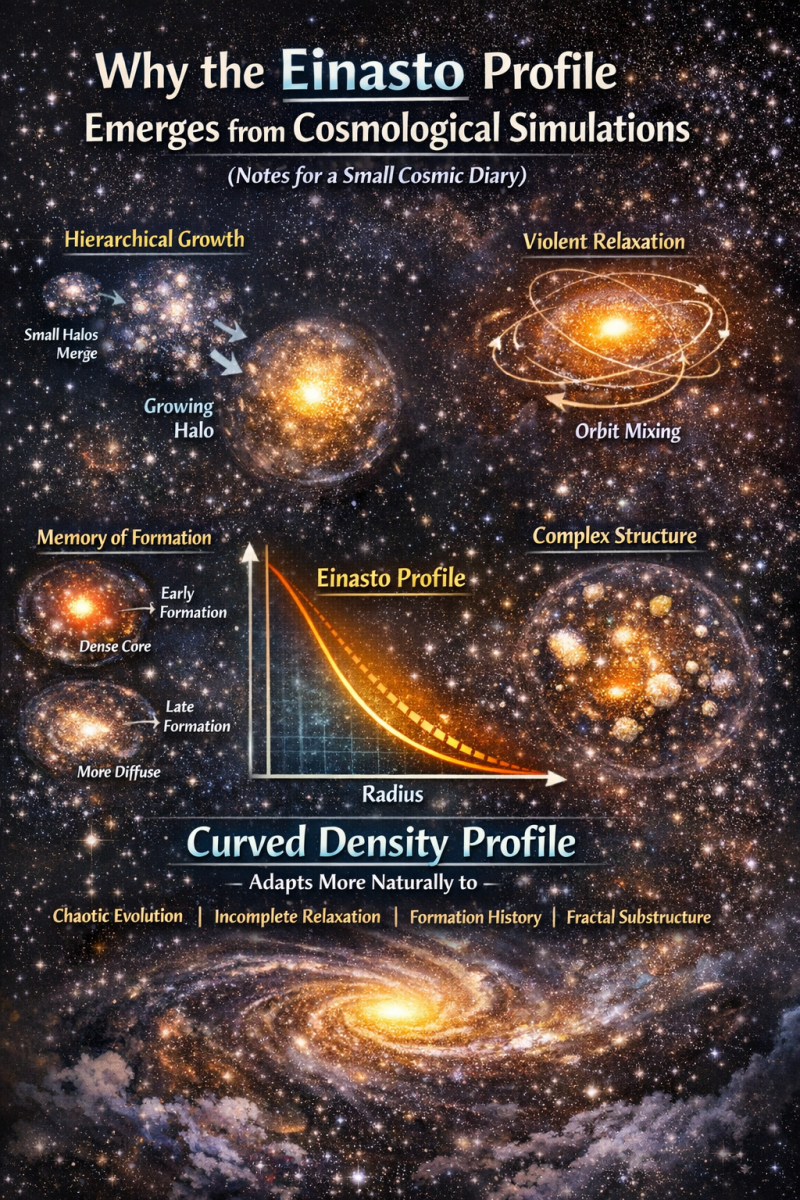
This is not just about better fits.The deeper point is that the Einasto profile seems to emerge naturally from the physics of halo formation.
1. Hierarchical growth
Halos are not born fully formed.They grow through:
-collapse of small structures
-mergers
-continuous accretion
This process is:
👉 chaotic
👉 non-linear
👉 dependent on individual history
Result:
❌ no perfectly universal structure
✅ but a family of similar profiles with subtle variations
And that is exactly what Einasto captures.
2. Violent relaxation
During mergers, the gravitational system:-redistributes energy
-mixes particle orbits
But this process is not perfect.
👉 it does not lead to a simple equilibrium like an ideal gas
👉 it preserves traces of the dynamical history
So the final profile is:
-not a simple law
-but something smoother, more curved
Once again: very Einasto-like behavior.
3. Memory of formation
A crucial, often underestimated point:👉 halos remember their past
For example:
-early formation → more concentrated
-late formation → more diffuse
This memory affects the shape of the profile.
NFW struggles to incorporate this.
Einasto can, thanks to its shape parameter.
4. Almost fractal structure
Simulations show that halos contain:-substructures
-anisotropies
-local fluctuations
They are not smooth objects.
The average profile emerges from many overlapping components.
👉 a superposition of complex effects
👉 producing a smooth, gradually changing curve
Once again: Einasto naturally appears.
So is Einasto “the truth”?
Not quite.It’s important not to be misled:
👉 Einasto is not a physical theory
👉 it is an effective description
But it is one that:
-fits the data better
-reflects the underlying complexity more faithfully
And in astrophysics, that already means a lot.
A personal reflection
What I find most interesting is this:for years we searched for simple formulas to describe the universe.
Now we are entering a different phase:
👉 the data are so precise that they reveal the limitations of our models
And something beautiful happens:
it is no longer mathematics guiding physics,
but the complexity of physics forcing mathematics to adapt.
In summary
The Einasto profile emerges because:-halos form through chaotic, hierarchical processes
-gravitational relaxation is incomplete
-formation history leaves a memory
-internal structure is complex and non-uniform
👉 and all this naturally produces “curved,” non-rigid profiles
Perhaps the most interesting lesson is this:
the universe is not less elegant than we thought.
It is simply… a bit more complicated.