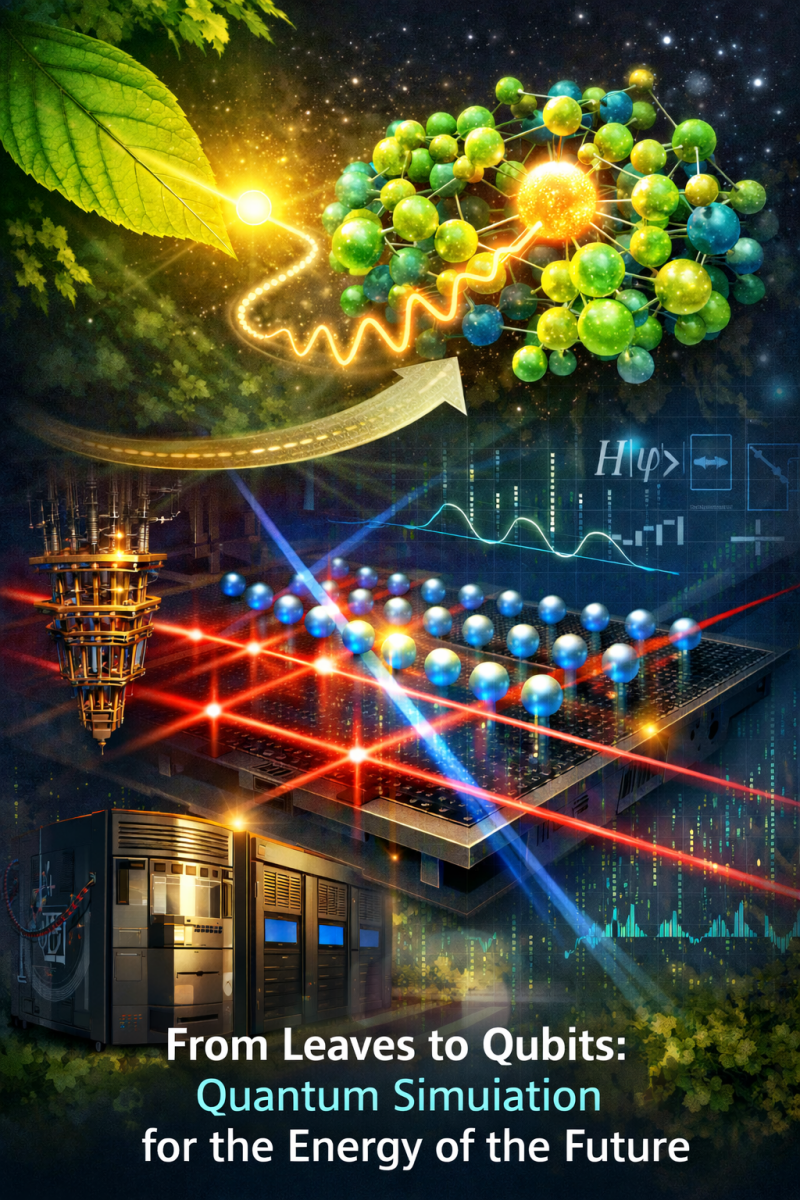
How Quantum Simulation Could Teach Us to Harvest Energy Better Than Nature Summary
Natural photosynthesis exhibits an extraordinarily high efficiency of energy transfer. Over the past two decades, it has become clear that this performance cannot be explained solely by classical diffusion models, but instead requires genuinely quantum ingredients. In this article, we explore how the concept of a quantum walk, together with the emergence of specialized quantum simulators—particularly those based on neutral atoms—can become a concrete tool to understand and replicate the physical principles underlying photosynthesis, with potential implications for the energy technologies of the future.
1. The Green Mystery: Why Energy Is (Almost) Never Wasted
Every leaf is a miniature power plant. When a photon is absorbed, its energy is not used immediately; instead, it must travel through a complex network of molecules, known as chromophores, until it reaches the reaction center, where chemical energy conversion takes place.
If this process were purely classical, the energy would move like a randomly bouncing particle, gradually dissipating as heat. Yet experiments show that the transfer of excitation energy occurs with an efficiency close to 100%.
In the mid‑2000s, ultrafast spectroscopic techniques revealed a crucial detail: for short but significant time intervals, energy appears to propagate in a quantum‑coherent manner. Rather than choosing a single path, the excitation explores many possible pathways simultaneously, a behavior well captured by the notion of a quantum walk.
The prevailing picture today is not one of pristine, long‑lived coherence, as in cryogenic laboratory systems, but something subtler: an open quantum system in which environmental interactions do not merely destroy coherence, but can actively enhance transport efficiency. This regime is known as environment‑assisted quantum transport.
The central question then becomes unavoidable: can we understand these mechanisms well enough to reproduce them artificially?
2. Why Classical Computers Fall Short
Mathematically describing a network of interacting chromophores governed by quantum mechanics is a computational nightmare. Each additional molecule dramatically enlarges the space of possible quantum states, leading to an exponential growth in complexity.
Even the most powerful classical supercomputers can handle only highly simplified versions of such systems. This limitation is not merely technological, but fundamental. As Richard Feynman already pointed out in the 1980s, simulating quantum nature with classical machines is inherently inefficient.
Feynman’s proposed solution was radical: use a controllable quantum system to simulate another quantum system. Not a universal quantum computer for every conceivable task, but a quantum simulator tailored to a specific class of physical problems.
3. From Vision to Engineering: A Pragmatic Quantum Path
For many years, discussions about quantum computing were dominated by a distant goal: the fully fault‑tolerant, universal quantum computer. Today, the focus is shifting.
A more pragmatic idea is gaining traction: give up universality in exchange for near‑term scientific utility. Rather than waiting decades, researchers aim to build devices capable of performing millions of useful quantum operations (megaquops) on carefully chosen problems, such as Hamiltonian simulation.
This is precisely the niche occupied by neutral‑atom architectures, such as those developed by QuEra. In these platforms, individual atoms are trapped and arranged using optical tweezers, forming highly programmable arrays. The key advantage is not scale alone, but co‑design: hardware, control protocols, and error‑mitigation strategies are developed together for a well‑defined purpose.
A critical aspect is the reduction of operations that are most costly from an error‑correction standpoint. By making many transformations transversal and intrinsically robust, circuits become shorter and the useful simulation time becomes longer.
4. Simulating a Leaf (Without Growing One)
How does this translate to the biological problem at hand?
The goal is not to reproduce a leaf atom by atom, but to build a controlled analogy of the relevant dynamics.
• Each neutral atom represents a basic quantum degree of freedom, analogous to an excited or unexcited chromophore.
• Interatomic distances and Rydberg‑mediated interactions allow researchers to program couplings that mimic those between real molecules.
• The system is initialized in a state corresponding to photon absorption and then allowed to evolve under a designed Hamiltonian.
By measuring how the excitation propagates through this artificial network, we gain direct insight into energy‑transport mechanisms. A classical supercomputer then analyzes the data, optimizes parameters, and suggests new configurations to test. The result is a powerful hybrid classical–quantum loop.
5. What We Can Learn and What We Cannot
The promises are substantial, but realism is essential.
On the scientific side, quantum simulators can help identify universal design principles: how disorder, geometry, and environmental coupling influence efficient energy transport.
On the technological side, the aim is not to copy the leaf, but to draw inspiration from it. Artificial materials, nanostructures, or molecular networks could be designed using these simulators as virtual testbeds, with potential applications in solar cells, artificial photosynthesis, and sensing technologies.
The limitations are clear. These architectures are not universal and are not meant to solve every computational problem. Yet for the quantum dynamics of complex systems, the simulation depths achievable today are already sufficient to deliver genuinely new scientific insights.
Conclusion
The path from leaves to next‑generation solar technologies runs, unexpectedly, through laboratories filled with cold atoms and lasers. Specialized quantum simulation is not a vague promise, but a concrete roadmap for understanding how nature exploits quantum mechanics to manipulate energy.
For physics, this is a particularly fertile moment: complex systems theory, quantum optics, and materials engineering are converging. Not to build a universal quantum computer tomorrow morning, but to answer a far more focused—and perhaps far more important—question: how can we make energy transport as efficient as it is in a leaf?