The Answer is More Incredible Than You Imagine.
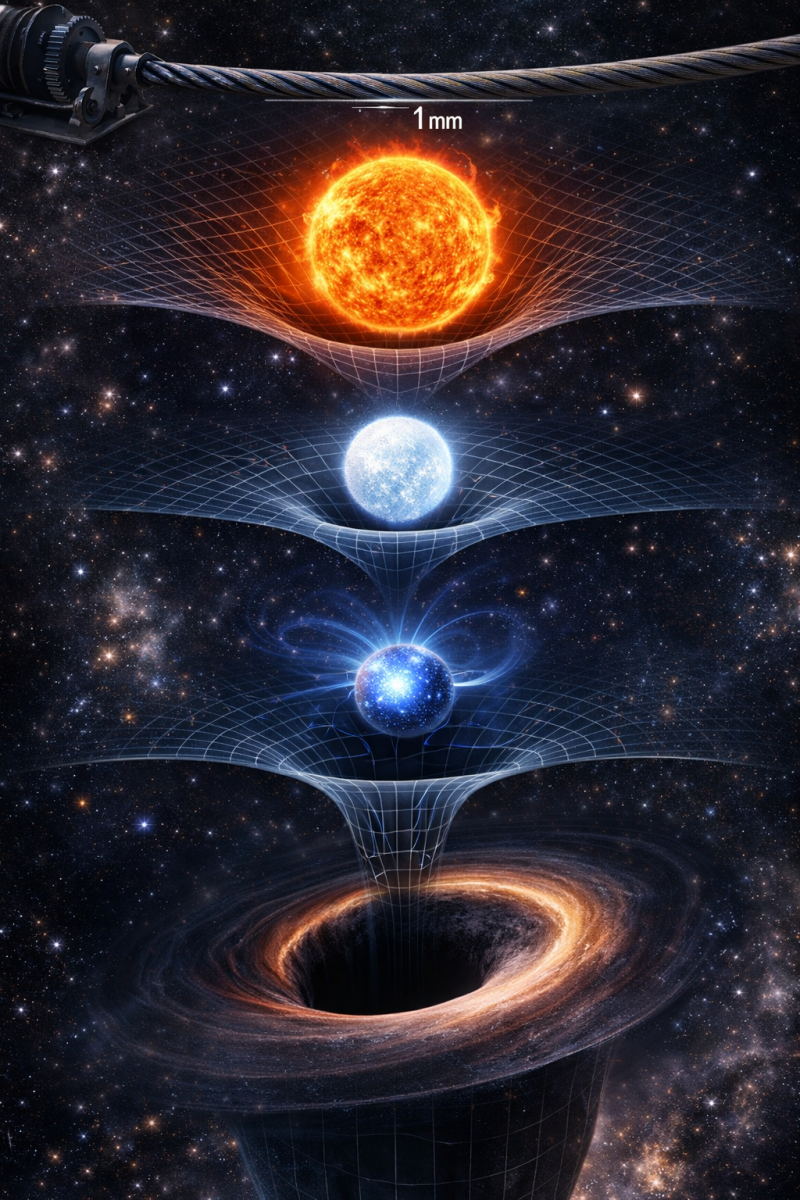
We're used to seeing it represented as a rubber sheet, bending obediently under the weight of a bowling ball. It's a powerful image, but a profoundly misleading one. Reality is almost the opposite. Take our Sun. A sphere of plasma containing 1.989 × 10³⁰ kg of mass. An incomprehensible number. It's a mass so great it would instantly disintegrate any structure, mountain, or entire planet that dared to touch it. And yet, what does this monstrous concentration of matter do to the spacetime that hosts it? It warps it by only about 0.0002%. Think about that: all that mass manages to deform the fabric of the universe by a mere two millionths. It's as if the most powerful winch tried to pull a steel cable one meter thick... and moved it just one millimeter. No steel, no concrete, no nanotech alloy could withstand such a load without being pulverized. Spacetime does, barely noticing. To begin to see a visibly more pronounced curvature, you need the terrifying density of a white dwarf: a dying star compressed into a sphere the size of Earth, where a teaspoon of its matter weighs as much as a car. Here, the deformation starts to get serious. But it's with a neutron star that geometry gives way dramatically. Imagine one or two Suns crushed into a city just a few kilometers across. The curvature of spacetime becomes so extreme that light can be bent all the way back onto itself. And then, the ultimate limit: black holes. Here, the curvature is no longer just a growing number. It's a mathematical boundary, a sheer wall in the universe called the event horizon. Beyond that point, spacetime folds in on itself so radically that every path leads toward a theoretical point of infinite density, the singularity, where our known laws of physics cease to make sense. So the real question becomes this: what could the "fabric" of the universe possibly be made of, that appears so thin and malleable as to accept curvature... yet is, in reality, the most rigid and resistant material we can conceive of? Perhaps it's the wrong question. Perhaps spacetime is not a "material" in the sense we mean. Perhaps its apparent rigidity is the signature of a deeper law, written in the still-unknown language where quantum mechanics and gravity speak as one. One thing is certain: when we finally decipher the true nature of this immaterial canvas that holds us, a new science will be born. And we will look back on today's physics as we now look at the alchemists who dreamed of turning lead into gold: intuitive pioneers, on the threshold of a revolution. The journey is still long. But every time we look up at the sky, we are already observing the surface of this mystery.