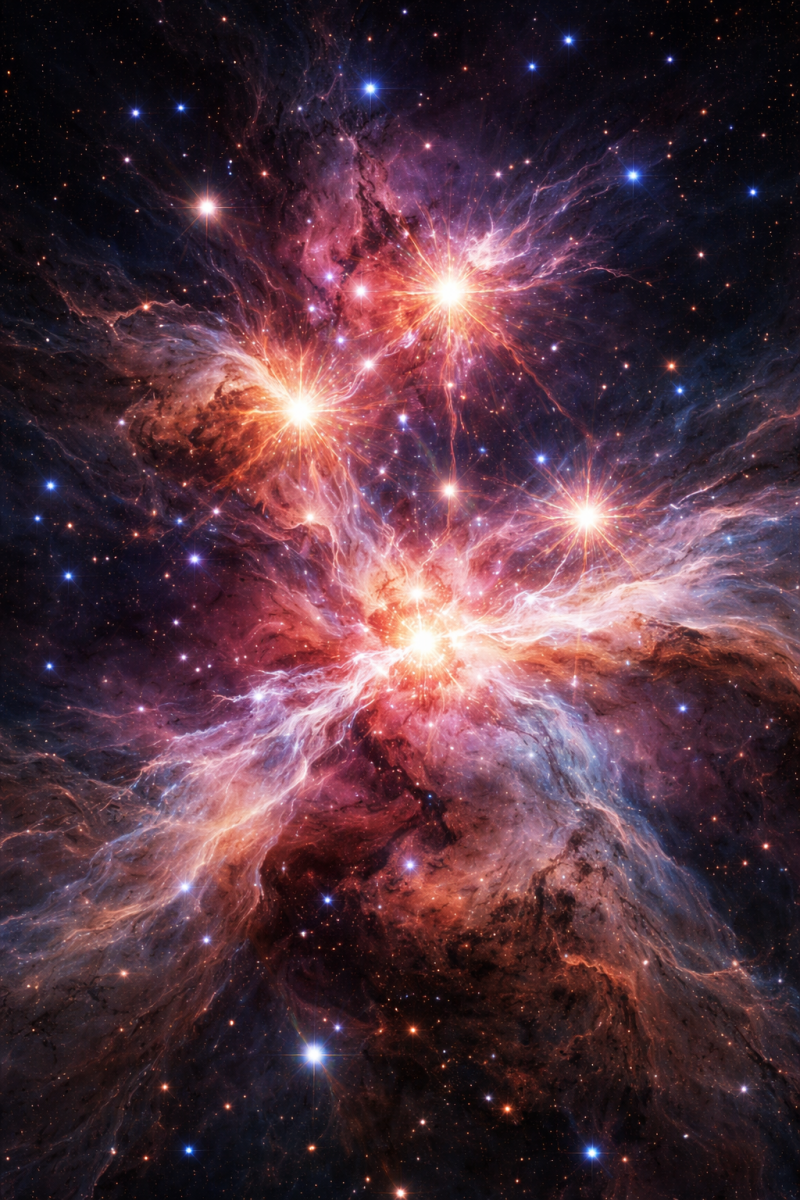
When we think of intelligence, we often picture biological or digital minds. But if we look at the cosmos with different eyes, we might discern the first form of "intelligence" right up there, among the stars.
Not a conscious intelligence, but a capacity to transform chaos into order, to process simple elements into complex structures, to influence and shape the surrounding environment. Here is how their very birth process resembles the formation of a mind.
1. Data Gathering: Molecular Clouds
Every intelligence begins from a vast "database" of raw information.
For stars, this database is nebulae—immense clouds of hydrogen, helium, and cosmic dust. A disordered, silent archive waiting to be "processed."
2. Forming the Neural "Cores": Pre-stellar Cores
Within the chaos, denser structures begin to form: clumps and then cores.
Like the first neurons clustering in a developing brain, these nuclei become the centers of gravitational processing. Here, matter starts to organize, contract, and "calculate" its own collapse.
3. The Ignition of "Consciousness": Nuclear Fusion
When the core reaches a critical density and temperature, the "Eureka moment" occurs: nuclear fusion ignites.
Hydrogen transforms into helium, releasing energy. It is the first stellar "thought": a reaction that orders matter according to the laws of nuclear physics, giving off light and heat. The star lights up, achieving a perfect balance between gravity (pulling in) and radiation pressure (pushing out).
This is thermonuclear intelligence: knowing how to maintain a dynamic equilibrium for billions of years.
4. Learning and Influencing the System
A star does not live in isolation.
It processes light elements into heavy ones (from carbon to iron, in the most massive stars).
It generates magnetic fields, stellar winds, and often a planetary system.
It communicates through gravity and radiation with its surroundings.
Like a mind that learns and modifies its environment, a star shapes its galaxy, preparing the ingredients for new stars, planets, and perhaps life.
5. Cosmic Memory: The Stellar Legacy
At the end of its cycle, a star releases the elements it has synthesized into the cosmos.
Supernovae, planetary nebulae, white dwarfs, neutron stars, black holes: each is an "archive" of chemical and physical knowledge, a seed for future cosmic generations.
Conclusion
Stars do not think, but they process.
They do not reason, but they order.
They have no purpose, but they create the conditions for every subsequent form of intelligence to one day emerge.
They are the first, majestic thermonuclear intelligences, which transformed a simple, opaque universe into a cosmos that is transparent, complex, and rich with possibility.